
A script is a next action with words on it. It does not close the case. Replace the brackets with your practice's own name, hours, and phone number. Do not add procedure names, fees, or clinical detail. Praxora does not diagnose, and these lines are not clinical advice.
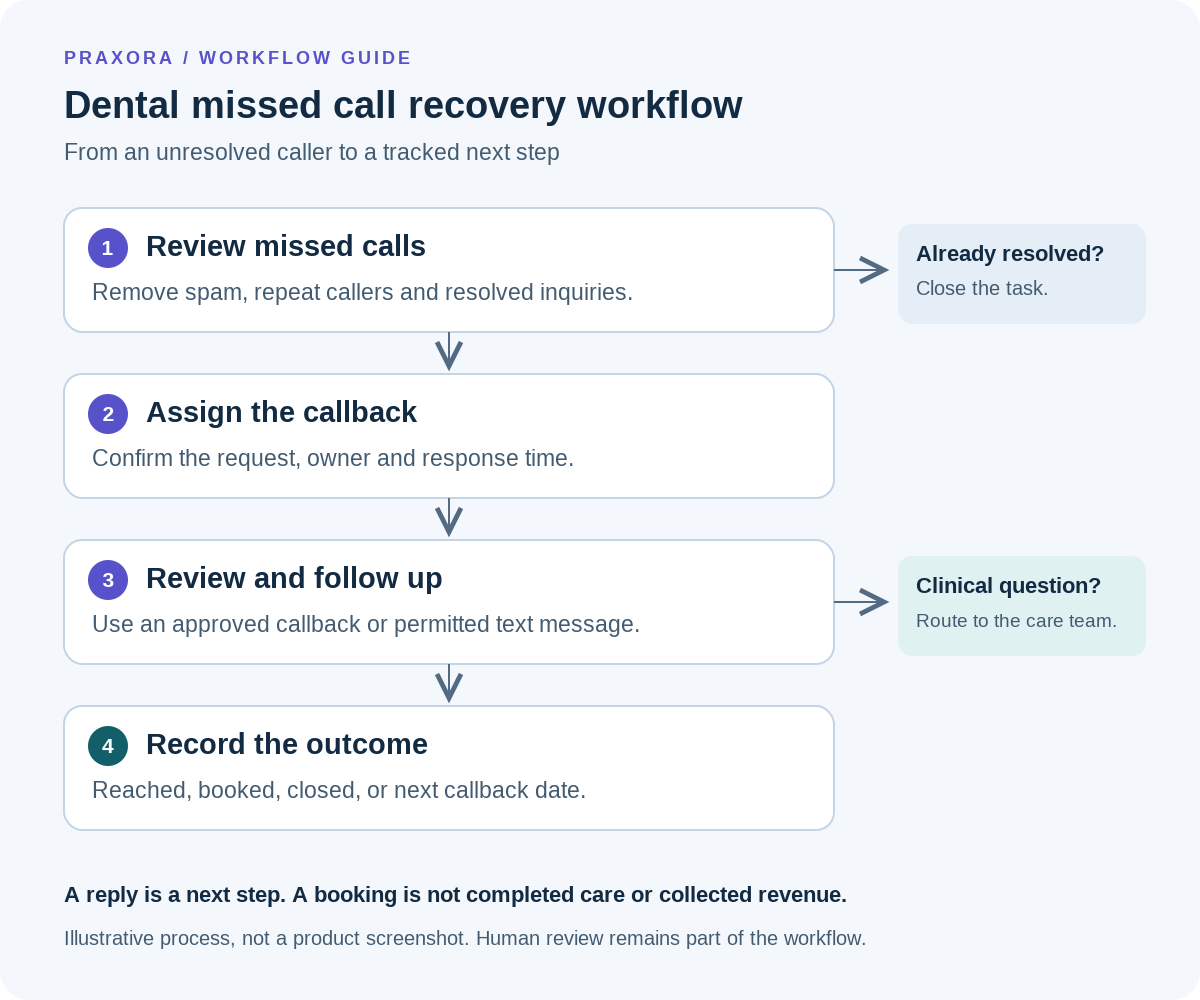
The workflow around the words is dental missed call recovery. An automatic text is a different layer: see missed call text-back vs recovery. A phone system or an answering agent may catch the first ring. That is the comparison on Weave vs follow-up recovery and AI dental receptionist vs follow-up recovery. These scripts start after the miss is already a fact. Medspa front desks can use the same shape on medspa missed-call recovery.
Before you dial
- Confirm the caller is not already booked and has not already been reached about this miss.
- One owner. If two people might call, pick one.
- Know the category you actually have: new patient, existing patient scheduling, treatment follow-up, billing, or unknown. Unknown stays unknown.
- Honor a do-not-call note or a requested time already in the chart.
- If the only record is "someone should call them back," the case is not ready. Assign the owner first. The full checklist is on missed call ownership.
No answer
When the callback rings out, there is nothing to say. Log the attempt number and the time. "No answer" is an attempt, not an outcome. The case stays open.
- If nobody has left a voicemail yet in this callback cycle, use the voicemail script next. Do not skip straight to "we tried."
- If a voicemail was already left today, do not leave a second one the same day unless the practice's own policy says to.
- Set one next attempt on the next business day, or close the case as unable to reach after the attempt limit your office already uses. Write that limit down. An unwritten limit means the row never closes and never gets a real second try.
Voicemail
Say: "Hello, this is [Name] at [Practice]. You called us and we missed you. I am returning that call. You can reach us at [front-desk number] during [hours]. If you would rather we call you, call and ask for [Name]. I will not leave treatment or billing details on this voicemail."
Stop there. Do not name a procedure, a tooth, a fee, or an insurance estimate. Do not say the patient is overdue. If the right next step is a text, and the patient has agreed to texts, use a short general message. Treatment-specific patterns, for cases that are actually unscheduled treatment, are on unscheduled treatment text samples.
After you hang up, record: voicemail left, time, owner unchanged, outcome still open, next action is the patient's reply or the next attempt date.
Live callback
Say: "Hello, this is [Name] at [Practice]. Am I speaking with the person who called us? We missed your call. I can help with scheduling, or I can get you to the right person. What were you calling about?"
Then stay inside what you can actually see:
- They want a time. Offer two openings you can see on the book, or take a preferred window and a callback time. Do not promise a slot you cannot see.
- They already booked. Confirm it, thank them, and close the callback as already resolved.
- They want to think. Agree a date. The date is the next action. "Thinking" without a date is still an open leak.
- They ask about a fee, a plan that was presented, or a clinical question. Stop. Use the treatment-coordinator script. Do not quote a fee from memory.
- You reached the wrong person or a wrong number. Apologize, end the call, and record unable to reach or bad number. Do not leave a detailed message with someone else.
Escalate to the treatment coordinator
Say: "I want to get this to [Coordinator name], who can look at that with you. I am not going to guess at the fee or the treatment on this call. [Coordinator] will own the next call. Is [window] a workable time, or should they use the number you called from?"
Then change the row:
- Owner becomes the treatment coordinator, not "the clinical team."
- Next action is that call, with the window the patient just gave you.
- Outcome stays "needs staff follow-up" until the coordinator records scheduled, declined, waiting on insurance, unreachable, or closed.
- The front desk does not keep a second copy of the same callback.
If the coordinator is the one who should have had the case before the first dial, fix the route for next time. The script is the handoff. It is not a reason to leave clinical questions with whoever happened to return the miss.
Frequently asked questions
Are these scripts for the first ring, or for the call back?
They are for the human callback after a call was already missed. An automatic text-back can acknowledge the miss. It does not replace the no-answer log, the voicemail, the live callback, or the handoff to a treatment coordinator. The difference is spelled out in text-back vs recovery.
Should voicemail mention the treatment or the fee?
No. Leave a short message that you missed their call and how to reach the office. Do not leave procedure names, fees, insurance details, or clinical information on voicemail.
When does the front desk stop and hand the call to the treatment coordinator?
When the caller asks about a fee, a presented plan, insurance for that plan, or a clinical question. The front desk sets the next time and changes the owner. It does not guess at the answer.
To review how missed calls are handled today, use the free follow-up leak review. Describe the callback path in aggregate. Do not include caller names, numbers, or message transcripts. A directional count of unresolved misses can go in the revenue leak calculator beside unscheduled treatment and overdue recall.